Blog

#WZAOC Workout 3 Strategy and Lesson Plan

Week 2 of the Wodapalooza Online Qualifier is upon us, and we’re back with another strategy and lesson plan for Workout #3.
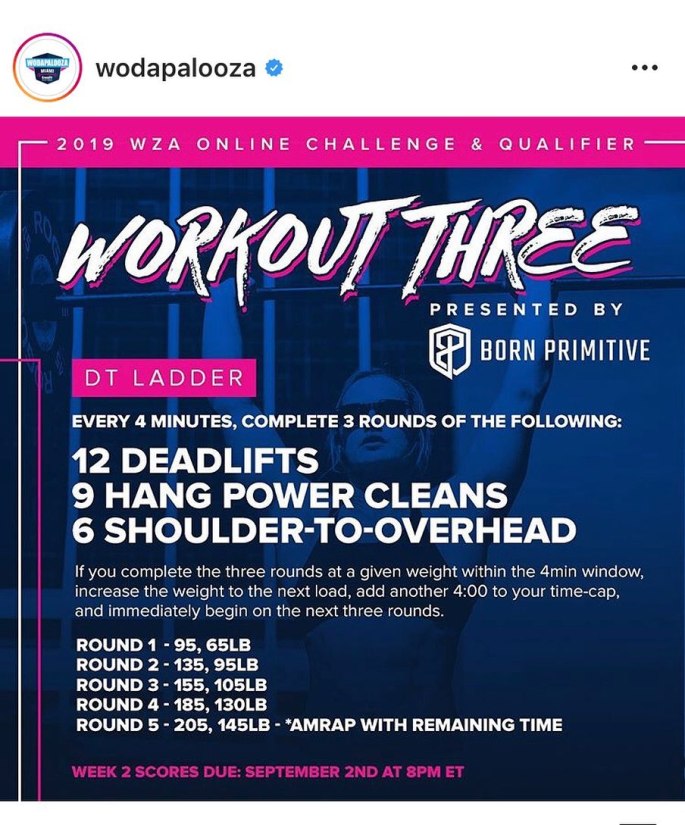
WOD 3 of the the #WZAOC is a DT ladder and part of tomorrow’s Daily WOD. 
#crossfitfamily 
@wodapalooza @rxlab @caribbeancrossfittercommunity

Workout # 3 is a ladder of the classic CrossFit Hero Workout “DT”. Traditionally, DT is 5 rounds at 155 lbs for men and 105 lbs for women. The qualifier calls for every 4:00 until failure to perform three rounds of DT at ascending weights. Those weights are:

Round 1: 95 / 65
Round 2: 135 / 95
Round 3: 155 / 105
Round 4: 185 / 130
Round 5: 205 / 145 * Continue in AMRAP fashion until the 20:00 mark.

Alternate weights: 75/55
95/65
115/75
135/95
155/105

Strategy

Reread the workout and note, that before you get to the traditional DT weight, you will need to do six rounds, or one more round than traditional DT. While “Heavy DT” at 205 / 145 is fairly prevalent in competitive CrossFit circles, do not discount the first six or even three rounds. A goal time often thrown around for DT is ~8 minutes, and you have to do one extra round- using a lighter weight- in under that time, in order to get to the traditional 155 lb / 105 lb barbell.

Approaching the Workout- This is a workout where you will likely have to reign yourself in at the beginning, and then be a disciplinarian on yourself as you progress through the heavier weights. It is better to have short controlled breaks at the beginning of this workout, than to rush and go completely unbroken in order to “buy yourself time.” You’ll likely just spend that time hunched over the barbell staring at it. Figure out how long you want to rest, and make sure you rest on the clock, and not in your head. Quick short breaks when the barbell is light, and keep them that way as the weight gets moderate. Once it is heavy, you will likely have to break longer, but you should know about what that weight is already in looking at this workout. Even still, keep your rests short and disciplined, and if you have a judge, even better to have them keep you honest on your rest.

Breaking it up- This is the same as regular DT. Break the deadlifts at the 11th rep, because you have to deadlift the bar before beginning the set of hang power cleans, and break the hang power cleans at the 8th rep because you have to get the bar to your front rack for the shoulder to overheads. Even if you can do the first bar completely unbroken, I would not recommend it. I would absolutely briefly break at the 11th deadlift in each round, as a quick :03 to: 05 second break costs you nothing but can keep your heart rate from spiking. Even breaking on the 8th hang power clean likely won’t cost much time in the early rounds, but could save some fatigue and cycle rate later.

The movements- Deadlifts- The deadlifts are the easiest part. If you can maintain a clean grip that’s great, but it’s not a huge time saver as if you are breaking on the 11th deadlift, you can go from mixed grip to clean grip before starting your hang power cleans.

Hang Power Clean- The hook grip is super helpful here, and if you can hold the hook grip into your front rack, all the better. Bouncing your Hang Power Cleans out of the pocket is the way to go (see video in lesson plan); the longer you hold the bar at your hips, the more grip you are using, and the more likely you are to break. Keep your focus and a tight core to keep a fast cycle time, as getting lazy will slow you down, tax your grip, and likely lower back.

Shoulder to Overhead- Yes, you can push press this, but why would you? The extra half a second you’re shaving not doing a push jerk is likely to cost you later in the form of shoulder fatigue. Use your legs.

Lesson Plan

0:00-5:00 Intro and Whiteboard– Say hello and talk about the workout. You can mention that this workout is based on the Hero Workout “DT.” Details for the namesake of this workout, originally posted on Crossfit.com on April 14, 2009 are included below:

In honor of USAF SSgt Timothy P. Davis, 28, who was killed on February 20, 2009, supporting operations in OEF when his vehicle was struck by an IED. Timothy is survived by his wife Megan and one-year-old son T.J.

6:00-15:00 – KB Flow Warmup: Have your athletes grab a moderate KB and lead them through a solid KB flow to activate their posterior chain, core, shoulders, and legs. Suggestion:

10 KB Deadlifts
10 KB Halos (around the head)
10 Russian Swings
5 KB Figure 8’s through the legs each direction
10 Single-arm Russian KB Swings
5 KB goblet squats with a :03 pause
5 KB Push Press each arm
10 Taters (Russian swing into a goblet squat)
10 American Swings
5 KB Clean and Jerks each arm

You can lead them through this once, and then have them go through it again on their own. Feel free to adjust as the flow may hit you. Get your athletes comfortable using the KB and moving with it.

16:00 – 27:00 – Barbell Warm-up: Have your athletes get away their Kettlebells and grab barbells.  Run them through the following:

5 Good Mornings
5 Back Squats
5 Strict Press
5 Front Squats
5 Deadlifts

Let them shake it out, then get the clean warmed up. Run them through:

5 Jump and Shrug
5 High Hang Clean Pulls
5 Muscle Cleans
5 High Hang Power Cleans
5 Power Cleans 

One of the things that will really help your athletes today will be fast elbows. If you ever see an athlete that lands in their power position with low elbows, only to raise them when they stand up, you can have them perform some elbow transitions. Have them hold the bar or a PVC pipe in a high pull position with their elbows high. From there, have them shoot their elbows through and go right into their front rack.

From there, hit the shoulder to overhead and run through:

5 Strict Press
5 Dip and Hold
5 Push Press
5 Push Jerk   

It is worth taking some extra time to talk about cycling the clean into what’s often called the “bounce” clean, where athletes shoot the barbell directly from their pocket back up to their front rack position. Check out this video from MisFit Athletics on the bounce clean to help demo to your class:

27:00-35:00 – Strategy and Warm-Up: Talk to your athletes about breaking up this workout intelligently, resting on the clock, and where they estimate and are looking to finish. The cut-offs are: 4:00, 8:00, 12:00, 16:00 and 20:00, so make sure you either call those out or have your clock set to alert the athletes to those cut-offs. Have your athlete build up to the weight in the round that they want to hit, and have them work through several rounds with ascending weight of:

7 Deadlifts
5 Hang Power Cleans
3 Shoulder to Overheads

Do not have your athletes simply treat the first few rounds as a warm-up. Nobody should be close to setting PR’s, but make sure they are well-primed for all these movements and get more than the first round weight on the barbell before they start.

36:00-56:00- Workout !!! Note: many athletes may finish within the first 8 minutes, or even 4 (though hopefully not if they scaled appropriately), you can have them grab foam rollers for hamstrings and shoulders, or just cheer on their friends and have them help change out weights between rounds as other athletes can help change weights. This is the reverse of the usual scenario when firebreathers finish a for-time workout early, but in either case, I usually discourage having other athletes clean up while people are still working. 

I hope you enjoyed this piece and this lesson plan! If you know anyone running this workout, make sure to send this along to them for ideas and help running their affiliate through this workout!



WZAOC Workout 2 Strategy and Lesson Plan

The Wodapalooza Online Qualifier is in full swing, and both the first and second workouts are live! The first one was fast and dirty, and the second one is mostly just dirty.

Below is the workout video:


It is:

16 Min AMRAP:
40 Alt. DB Snatch 50 / 35
40 Pull-Ups
30 Burpees w/ DB (50’s / 35’s)
30 C2B
20 Devils Presses (50’s / 35’s)
20 Bar Muscle Ups

The alternate (“scaled”) version is:

40 Alt DB Snatches (35, 20lb)
40 Jumping Pull-ups
30 DB Burpees
30 Ring Rows
20 Devil Presses
20 Pull-Ups

Wodapalooza’s site also has adaptive seated, and adaptive standing RX/alternate versions as well.

Strategy

DB Snatch – These can be unbroken if you are proficient with the DB snatch. If you’re concerned that your grip is not going to hold up, then break this up as you need. 20/20, or 25/15 should be fine. Keep your legs involved, and try to redip without slowing your cycle rate. Using your back too much will come back to haunt your midline in the pullups, and the burpees and devils presses.

Pull-ups / Chest-to-Bar Pull-ups / Bar Muscle Ups- In all of these movements, break them up before you think you need to. This is most likely where you can really mess up your grip, and ruin the rest of your workout. Don’t go and do that set of 20 or even 40 pullups, even if you can. It likely won’t pay off as will a quick break and doing 4 sets of 10, 5 sets of 8, 8 sets of 5 or even singles if that is where you’re at. Always good to remember, that in general, you’re not going to magically be able to hold onto huge sets of a movement if you don’t regularly do that in your everyday training.

DB Burpees – These aren’t just normal burpees, you get to hang on to a pair of dumbbells. Don’t get lazy standing up in your deadlift and try to hang on to these as best as you can. They are going to be grippy, and gritty. I made the mistake of using smaller metal dumbbells instead of the larger rubber dumbells. That extra 1/2″ – 1″ makes a difference in the deadlift portion of the burpee. This is where you can really make up some time by moving efficiently and grinding through this movement.

Devils Press- This is the crux of the workout. They were in the qualifier last year, so everyone was on notice for them. If you didn’t practice, you may be stuck with them. Do your best, and if you have no other frame of reference, just treat them like a giant terrible kettlebell swing. You can push the pace by staying a little tighter and driving up more in a double DB snatch rather than swinging them out a la a kettlebell swing.

Transitions and Rest- Simple things on this workout. Be honest about how much rest you are going to need, and keep your DB close to your pull-up bar, and your chalk close as well. You can wear your grips and do DB burpees/devils presses, and avoid taking huge walks away from the equipment. Stuff like that adds up in a workout. Also, as my coach always says, practice resting on the clock and not in your head. Have an ideal rest time (ex. 5 seconds), a retreat rest time (ex. 10 seconds), and an if I’m resting longer than this I’m actually dying rest time (ex. 30 seconds, but it could be more than that for you and that’s okay).

Lesson Plan-

0:00-5:00 Whiteboard– Introduce the workout, warm-up Wodapalooza and the qualifier, and a question of the day.

6:00-15:00 Warmup-
Round 1: 20 Banded Good Mornings
10 Kipping Swings
8 Up-Downs (Burpees w/o pushup)
Round 2: 10 KB Deadlifts / 
10 Russian KB Swings
10 Strict Pull-ups
8 Burpees
Round 3: 20 American KB Swings
10 Kipping Pull-ups
8 Burpees 

16:00-22:00 – Banded Ham String Stretching – Have your athletes grab their band from the warm-up and find a space on the floor. Hooking the band just below the ball of their foot have them extend their leg to the ceiling. Lead them through a variety of stretches with each leg: leg straight, circles on the ceiling, flex their ankle, legs straight out to the side, legs across the body, etc.

23:00-33:00 – Kipping Pull-up Progression- If your athletes are going alternate for this workout, this could be a good opportunity for them to get their first pullup at the tail end of this workout. For most athletes, focusing on having a solid strong kip or butterfly will pull them through this workout. Have your athletes focus on a strong core and not breaking at the knees on their pull-ups to really get the most out of their kip. Have athletes perform the following:
:20 Dead Hang
10 Tight Kipping swings
10 Tap swings

After this, you can break out your athletes and have them figure out whether they’re doing alternate or prescribed for the qualifier and talk about more specific pull-up techniques with your athletes and give them time to practice. Each athlete should perform at least the following:
8 Kipping Pull-ups -> Butterfly Pullups
6 Chest-to-Bar Pullups
4 Bar Muscle Ups

34:00-40:00 DB Movements: Have your athletes grab their dumbbells. Talk quickly about the DB snatch and the importance of driving with their legs and keeping their chest high to save their back. Discuss staying tight in both the Devil’s Press and the Deadlift portion of the DB Burpee. Have your athletes grab their dumbbells and do the following:

12 DB Snatches (alt)
10 DB Deadlift
5 Double DB Snatches
4 DB Burpees
2 Devils Presses

If athletes are not doing the qualifier, make certain to help them choose an appropriate weight to have a good workout, especially on the devil’s presses.

42:00-58:00- Workout!

Make sure athletes record their scores and take a video if they are doing the qualifier!

This is a super fun workout, that really pushes people beyond their comfort zone. Have fun with this one, and I hope you found this helpful! Look for more content next week with the next wave of Qualifier workouts, and I’ll hopefully have the lesson plans up sooner since I won’t be traveling on vacation!

WZAOC Workout 1 Strategy and Lesson Plan

The WODAPALOOZA International Online qualifier kicks off TODAY, and last Monday, they released the first workout.

It is:

67935224_2543203655701997_7874549781022900224_n.jpg

AMRAP 9

3 Hang Power Snatches @ 75 lbs  / 55 lbs

3 Overhead Squats @ 75 lbs / 55 lbs

30 Double Unders

+ 3 Hang Power Snatches / Overhead Squats per round (3/3, 6/6, 9/9, 12/12, etc).

This is a spicy burner, and a good one to run through for a class. I’ll highlight quick strategy tips and provide an hour-long class lesson plan.

Strategy

As far as strategy goes, there are a few things to keep in mind as you go through these movements.

Snatches- There are three gears for this Hang Power snatch:

  • Bouncing the snatch out of your pocket as soon as it hits your hips is fastest.
  • You can also catch, go to some point in the hang for extra pop, and then drive vertically back into your hips with no break in between.
  • Finally, you can catch, pause, hit a strong hang position, and drive back up.

With any of these, you want to avoid catching the barbell below the pocket and heaving overhead with only our back. Below is a video demoing the three movements, and the fault.

Even though the next movement is overhead squats, focus on using your legs to pop this barbell back up. It is worth it to try to hold onto these and keep a steady rhythm, as the weight is light enough that it shouldn’t fatigue athletes too severely. If you do break these up, make sure to have a plan. Below are a few examples:

Set of 12- 5,4,3 / 6, 6 or 7,5

Set of 15- 6, 5, 4 / 8, 7

Set of 18 – 7, 6, 5 / 9,9 or 10, 8

Set of 21 – 8, 7, 6 / 10,11 or 12, 9

You have to get the bar overhead for the squats, so for example, if you want to break between the Snatches and Overhead Squats, make sure to do so before the last rep of the power snatches.

Overhead Squats 

You can lose time here if you’re not properly warmed up. Fast overhead squats will save your shoulders. While testing this workout, I had a slower cycle rate on my first couple sets of overhead squats in favor of better positioning and smoother reps. I eventually realized that this is where shoulder fatigue was setting in and picked up the pace in later sets. Make sure you take the time to warm up the overhead squat via soft tissue work and active mobility to ensure a fast cycle time. See above for rep schemes if needed.

Double-Unders

I heard Seth from MisFit Athletics once say: “For the best in the world, double-unders are rest.” Is that a reality for most of us? No. However, the more you focus on trying to breathe and relax into double-unders like they are rest, the better and more consistent they will become. There are only 30 double-unders, so take your time before each set to make certain you’re ready to start, as making a mistake will cost more time than an extra breath or two. Second, relax your body and focus on a steady breath and rhythm, rather than trying to push the pace. Failing a double under because you’re trying to go fast will cost you more time than doing them unbroken. Unless you’re the best in the world, then by all means, push the pace.

Grip

I did not find this workout particularly grippy, however, it could end up that way. Some thoughts on avoiding it.

On the power snatches, the lower you bring the bar into the hang, the more grip you will need. If you can continuously bounce it out of the hip pocket, your grip will only be taxed at the very point of contact before you explode back up. Don’t waste time holding onto the bar at your hip if you need a break.

On the Overhead Squats, don’t bother holding the hook grip. Find a comfortable position where you can slot that bar in overhead and rock and roll.

Lastly, on the double-unders, don’t hold the handles in a death grip. This taxes not only your grip but also your shoulders. Do your best to keep a loose grip on your rope handles so you can save your grip and shoulders for the barbell. Plus, your wrists will rotate easier.

Lesson Plan and Timeline

0:00-5:00 Whiteboard- Explain the workout, warmup, what the WZAOC is, and that you’ll be running the workout today in two heats.

Scaling Options haven’t been released yet, but a few suggestions:

  • Go to an empty barbell or PVC for newer athletes
  • The same # of Hang Power Cleans and Front Squats for athletes struggling with the Overhead position, could go to 95# / 65#.
  • 50 singles for the double-unders

5:00-13:00 WarmupJump Rope Yahtzee

Double-Unders/ Single-Unders: 1:00 practice plus 4 rounds: :30 sec on / :30 sec off

The goal is to match # of reps per round exactly. At the end add up over/under for each round after the first and do that many burpees.

Have everyone grab a jump rope. Tell people you want them to find their comfortable single under or double under pace. The goal here is not the maximum number of double unders or singles, but rather a steady continuous pace that is matched across all the rounds. You’ll be doing 4 rounds of :30 on / :30 off, plus an initial practice round. The practice round is just for people to get plugged in and jumping. In their initial round 1 of 4, they are to count how many doubles or singles they do. For each subsequent round, they must note how many reps above or below their initial round that they got. If they hit it dead on, have them yell, YAHTZEE! Have them add the total number over/under each round from the first, and have them complete that many burpees. If a member gets more than 15 burpees, let other members contribute to their burpee total.

14:00-20:00 – Shoulder Mobility and Lacrosse Ball Rolling– Have members grab a lacrosse ball and/or foam roller and have them roll out their upper back, scaps, lats, delts, and pecs in preparation for the overhead position.

21:00-30:00 – Snatch + OHS Warm-up: Lead your athletes through the following:

  • 5 Snatch Grip Shrugs
  • 5 Snatch High Pulls
  • 5 Muscle Snatches
  • 5 Behind the Neck Presses
  • 5 Overhead Squats

You can talk briefly about cycling the hang power snatch, and trying to bounce out of the hip pocket to increase cycle speed. Then have athletes do a few reps of:

  • 5 High Hang Power Snatch
  • 5 Hang Power Snatch
  • 5 Overhead Squats

31:00-36:00- Practice Round / Final Set-up: Have athletes load up the bar and do a practice round:

6 Hang Power Snatch

6 Overhead Squats

30 Double Unders / 50 Singles

37:00-46:00 – Heat 1- Have athletes go in heats and count each other’s reps cheer each other on. It’s great practice for the open and can lead to super-fun workouts. Really psych up your athletes to push each other.

48:00-57:00 – Heat 2- Final Heat! Full Send!

57:00-60:00 – Clean up and high fives. Make sure athletes have their scores.

Round of 3: 36 total reps

Round of 6: 78 total reps

Round of 9: 126 total reps

Round of 12: 180 total reps

Round of 15: 240 total reps

Round of 18: 306 total reps

Round of 21: 378 total reps

Round of 24: 456 total reps

Hope you enjoyed this lesson plan and strategy guide! I’ll be posting more lesson plans and strategies for the other workouts as soon as they’re released! Please like, follow and subscribe on Facebook, Instagram, and YouTube. If you have any questions or feedback, please feel free to reach out to me at seamus@dropping-in.com.


Dropping In

cropped-seamusartboard-6408x-2.png

One of my favorite experiences in CrossFit is dropping in to a new gym when I’m traveling or visiting. Every time I do, I am always inspired by the new Coaches and people I meet and the places I drop into. That’s the inspiration for this channel, Dropping In.

The CrossFit world in 2019 looks wildly different from the CrossFit world even just a few years ago. While the actual CrossFit brand is going through some changes, the CrossFit methodology is being adopted by more than just CrossFit gyms. Bootcamps, Orange Theory, F45, Functional Fitness classes, and various other group fitness companies are adopting the CrossFit model of constantly varied, high intensity, functional movement, but not calling it CrossFit.

Regardless of what you call it, athlete experience is highly dependent upon the person delivering the programming: the Coach.

General consensus will tell you that one of the most important assets a gym can have is its coaches. There are numerous courses, seminars, and programs for coach development. But after the weekend, or the seminar, or the camp, what is often left lacking for coaches is the day to day development, learning, resources, and forums.

I am a Coach at a CrossFit gym in Manhattan, and I am constantly striving to deliver the best hour of the day to my athletes and clients. What I am consistently looking for is more content and material that helps me to do that.

active-adult-athlete-barbell-body-bodybuilder-1552691-pxhere.com

There are a number of fantastic resources for athletes, affiliate owners, and Coaches, but most of the resources that I have found have a bent towards the former two, rather than for the Coach. A quick YouTube search leads to a ton of videos, but most lack details about integrating these things into classes or different cues. And while many professional coaches are also owners of their own gyms, many Coaches are choosing to focus on the very real and important skill of leading athletes from the front of that class.

Dropping In is aimed at the Coach. I will be trying to deliver stories, content, and resources for the people that are up in front of the whiteboard on a daily basis trying to help people crush their goals and become more capable humans.  You can expect: Podcasts, Blog Posts, Lesson Plans, Videos and more on this site, and via FaceBook, Instagram, and YouTube.

Perhaps most exciting, I’ve set up a Discord channel where Coaches can connect and share what’s working for them, seek feedback, brainstorm, and help each other grow. If you’re a Coach and want to join the channel, send me an email to seamus@dropping-in.com  with your name, where you Coach, and a link to your gym and I will get you set up on the channel.

I hope that this can create some of those same connections, and help to spark inspirations in others as well. Please don’t hesitate to reach out and say “Hello.”